Blue Gum Removal in Cape Town: What Every Homeowner Should Know
If you own property in the Western Cape, you have almost certainly encountered a blue gum tree. They are everywhere here - along roadsides, in suburban gardens, and standing tall on farmland. The species, mainly Eucalyptus globulus and Eucalyptus camaldulensis, was brought to South Africa over a century ago for timber and shade. But what started as a useful exotic has turned into one of the most persistent invasive species in the region. When a blue gum gets too big, too close to a house, or starts dropping limbs in a storm, the only real solution is professional blue gum removal.
I have been working as an arborist in Cape Town for over a decade. In that time, I have seen what happens when people try to handle these trees themselves. It rarely ends well. Blue gums are not like indigenous trees. They grow fast, they get massive, and their root systems are shallow but aggressive. A mature blue gum can reach forty metres in height with a trunk diameter of over a metre. That is a lot of weight coming down. And when the wind blows - which it does often here - the risk of a tree failure goes up dramatically.
Why Blue Gums Are a Problem in Cape Town
Blue gums are thirsty trees. They draw a huge amount of water from the ground, which is one reason they were planted in wetlands and along waterways in the first place. But that same thirst makes them a problem in urban areas. Their roots spread out looking for moisture, and they can damage foundations, paving, and underground pipes. I have seen cases where a blue gum root ball lifted a driveway by several centimetres, or cracked a swimming pool wall.
Beyond the property damage, there is the fire risk. Blue gums shed bark in long strips, and those strips pile up around the base of the tree. In the dry summer months, that bark becomes perfect kindling. A spark from a braai or a discarded cigarette can turn a garden into a fire hazard very quickly. And because blue gums contain volatile oils in their leaves and wood, they burn hot and fast. That is not something you want next to your home.
Then there is load shedding. Yes, load shedding. When the power goes out, so do the pumps that many properties rely on for irrigation or borehole water. A stressed blue gum that is not getting enough water can become unstable more quickly. I have done urgent call-outs after a bout of load shedding where a blue gum suddenly dropped a major limb onto a roof. The tree was fine for years, but the combination of dry conditions and sudden water stress pushed it over the edge.
What Professional Blue Gum Removal Involves
Blue gum removal is not a job for a handyman with a chainsaw. It requires a proper site assessment first. Every tree is different. The location, the lean, the surrounding structures, the access for equipment - all of that has to be considered. A good arborist will walk the property, look at the tree from every angle, and check for signs of decay or cracks. That assessment guides the whole plan.
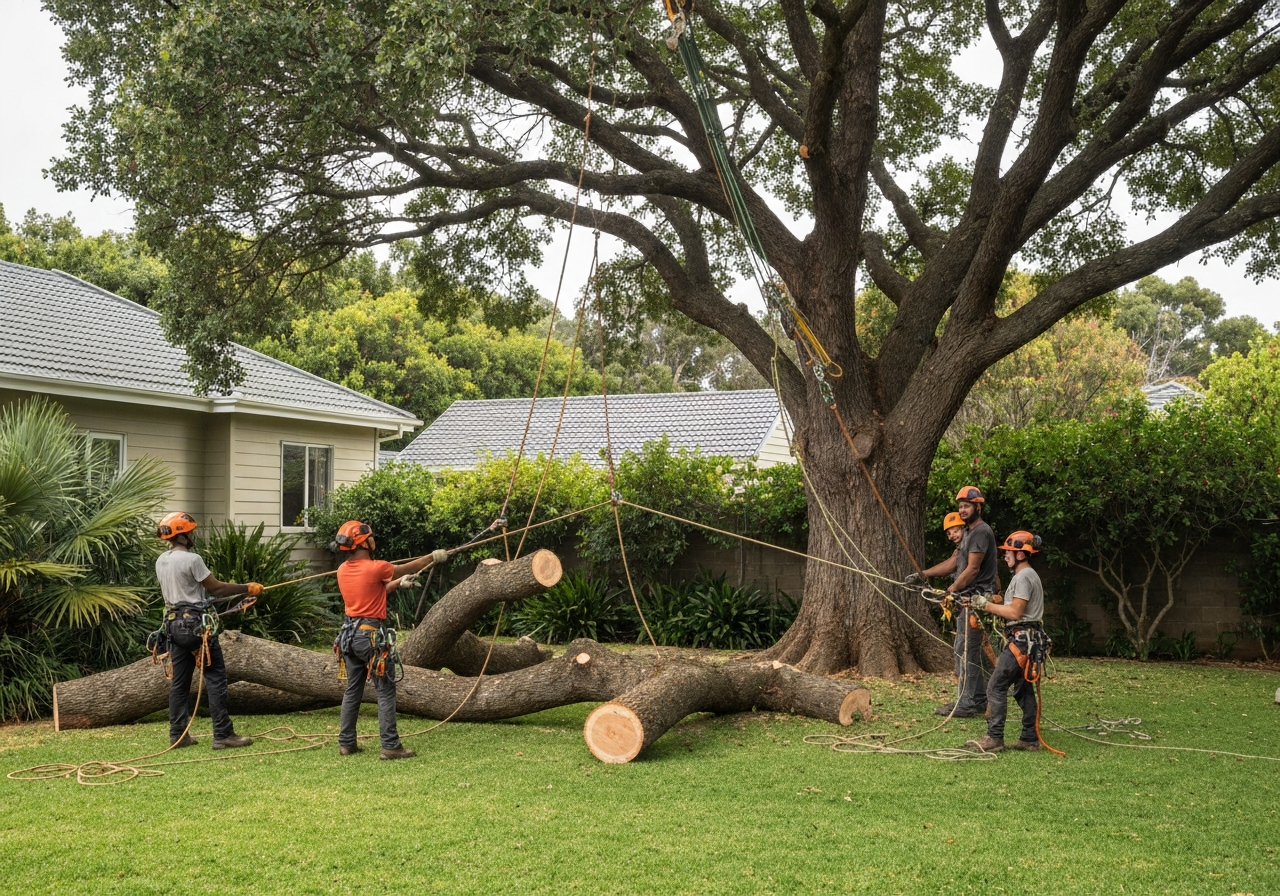
Sometimes the tree can be felled in one piece. If there is enough clear space and the tree is sound, tree felling is the simplest approach. But in tight spots - and most suburban gardens in Cape Town are tight - we have to take the tree down in sections. That is where a crane truck comes in. The operator lifts each piece of the trunk and drops it into a clearing, while the arborist works from a harness, cutting the tree from the top down. I have done that dance many times with blue gums. It is precise, slow work. One wrong cut can send a section crashing through a neighbour's fence.
Chainsaw safety gear is non-negotiable. I wear a helmet, visor, ear protection, chainsaw chaps, and steel-toe boots every time I start a cut. The moment you get casual is the moment you get hurt. And with blue gums, the wood can be hard and stringy, which puts extra strain on the saw. A sharp chain and proper technique are essential.
Once the main trunk is down, the branches go through a wood chipper. That turns them into mulch, which can be left on site or taken away. The mulch is useful for garden beds, but it has to be used carefully. Fresh blue gum mulch can be acidic and may affect some plants. I always tell clients to let it age for a few months before spreading it around sensitive vegetation.
Stump Grinding and the Root System
After the tree is gone, you are left with a tree stump. And blue gum stumps are stubborn. They do not rot quickly. In fact, a fresh cut stump will often send up new shoots from the root system. That is the tree trying to regrow. If you do not deal with the stump, you will be back to cutting suckers within a year.
A stump grinder is the tool for the job. It chews through the stump and the upper part of the root ball, grinding everything down to about thirty centimetres below ground level. That removes the regrowth potential and leaves a hole that can be filled with topsoil. For larger stumps, the grinder might need several passes. It is loud, dusty work, but it beats digging the stump out by hand. I have dug out blue gum stumps with a pick and shovel. It takes days, and you still end up with a crater.
If you want the root ball removed entirely - say, to plant a new tree in the same spot - that is a bigger job. It usually requires an excavator and a bit of digging. But for most homeowners, stump grinding is the practical middle ground. It removes the hazard and the regrowth without turning the garden into a construction site.
Bush Clearance and Large-Scale Removal
Some clients are not dealing with a single blue gum. They have a whole patch of them, maybe on a smallholding or a piece of land they want to develop. That is where bush clearance comes in. It is not just about cutting down trees; it is about clearing the site so that something else can happen there. Blue gums in dense stands create deep shade and drop thick leaf litter that smothers other plants. After removal, the soil often needs rehabilitation before you can plant indigenous species.
I worked on a project near Stellenbosch a few years ago where the owner wanted to turn a blue gum plantation back into fynbos. We spent weeks cutting, chipping, and grinding. The site was thick with saplings and coppice regrowth. Every stump had to be ground or treated with herbicide to stop it resprouting. It was hard work, but the result was a piece of land that could finally support local biodiversity again.
Choosing the Right Arborist
Not every tree felling company is equipped for blue gum removal. You want someone who knows the species, has the right insurance, and uses proper equipment. Ask about their experience with big eucalypts. Ask whether they include cleanup in the quote. Ask how they handle stump grinding and whether they can bring a wood chipper on site. A professional will walk you through the whole process and give you a clear price based on tree size, location, and access.
Blue gums are magnificent trees in their own way. They grow fast, provide shade, and have a distinctive scent after rain. But they are also a handful. If you have one that is causing problems, do not wait until a storm makes the decision for you. Call a qualified arborist and get a proper site assessment. The cost of removal is almost always less than the cost of repairing a damaged roof or a cracked foundation.
Blue gum removal is a job that demands respect for the tree and for the people and property around it. With the right approach, it can be done safely, efficiently, and with minimal disruption to your garden. That is the goal every time.
Ends · BLUEGUMREMOVALWAY